

How Training for an 80km Mountain Ultramarathon Makes me a Better Artist and Designer

I used to run to clear my head. Now I run to understand it.
Why I signed up for an 80km ultramarathon
Yes, you read that right. 80 kilometres. I am training for an EIGHTY-FREAKING-KILOMETRE ultramarathon… with 3,800 metres of elevation gain (and about the same amount of descent)... in the peak of Quèbec summer… on some of the most technical terrain found in the region. On paper, it is an absurd thing to choose, 14+ hours non-stop on technical trails, a 3am alarm to get to the start line, consuming more gels than I can bear to even think of, dealing with peak heat and humidity, maybe even some rain, and who knows what else.
But I did choose it. In fact, I’ve chosen it every day for the past five months.
Not because I expect it to be easy, or even enjoyable every moment of the way (although I do hope there are some enjoyable moments and I am not just cramping and puking my guts out the entire time!). I chose it because I have become interested in what happens when I commit to something that feels slightly beyond me and what I believe I am capable of. Running an ultra is terrifying, but it’s also teaching me that growth doesn’t all occur on race day. Most of the time, growth looks like putting on your shoes when you would rather stay curled up in bed, continuing uphill when your body starts negotiating that walking downhill would definitely feel better, and choosing to make weekends your long run days instead of coffee dates and brunches with friends and family.
So sure, it’s not miraculous, nor is it pretty, but it does create a lot of space for growth. And growth is very rarely ever pretty or miraculous. And it kind of has to be gritty and unpleasant doesn’t it? In order to grow beyond the bounds of who we are and what we are capable of we have to step into (or in my case run into) unknown territory and risk mistakes, failure, and probably at least a little bit of pain.
So, all this to say, I signed up for this race because I love running, but I also signed up because I want growth, and I know that whether I cross that finish line or not, I trained for five months for something hard.
But, before I delve into how all of this is connected to graphic design and art, I need to give you a bit of a backstory on my running journey because running doesn’t have to be the way that you find growth, it’s just the way that I have.
My history with running: from the road to the trails
I wasn’t always a runner, although it was always a part of my life in some way. Many of the sports I played required running, but I never ran just to run. I largely found running and my love for it in university as a way to cope with stress and to force me to step away from the computer. What started as something that felt like a chore slowly evolved into something I kept coming back to as a way to “breathe”. I don’t think I realised it at the time, but running became so much more than purely exercise at that point.
And then enter trail running…
I didn’t discover that until grad school when I moved out to the west coast of British Columbia and started running on local trails that were close to my home. Combine that with connecting with a few like-minded people who also loved trail running, and all of a sudden you’re stumbling into a whole new world, root-tripping, toe-stubbing and all.
The sport slowly evolved for me over the years, but it wasn’t until more recently, in the past two years that I took it more seriously and started training for specific goals - like trying for a sub 2-hour half marathon (I crushed that one, woohoo!), or a sub 4-hour marathon (that one didn’t happen but I learnt a lot!), and even running a 30km trail race with 1500m elevation (it was glorious even though the weather ensured there were no views to take it all in). It didn’t take long for me to jump to an ultramarathon as the next goal, especially after getting to see firsthand what it’s like to run an ultramarathon - I was lucky enough to crew my fiance for his first 100km ultramarathon in the mountains of Switzerland (can’t get much better than that can it?)! To say he’s had some influence on my running goals would be an understatement.
And this is where I noticed that my mindset and physical capabilities really started to change. And while I think growth can happen without specific goals, having them helped me focus on key aspects of my running, like speed work, muscle fatigue training, and technical footwork, and setting goals were what helped me to challenge myself, especially in places where I felt weaker or less confident.
And what does all of this have to do with design and art? Don’t worry, I’m getting to it in the sections below.
Completing an ultramarathon is not a one-day thing
An 80-kilometre ultramarathon with 3,800 metres of elevation is difficult to comprehend as a single thing. When I think about the distance and elevation I have to complete, and the number of hours I will be spending outside in the grueling heat and humidity, it feels almost abstract - too big, too steep, too long… how can I ever possibly run for 14+ hours?!
That is why the race cannot really be prepared for in one day, or even in one long run. You can’t just go out and wing it … unless you're Courtney Dauwalter or Kilian Jornet, then sure, maybe you can. The preparation for this race is built slowly in the early weekday kilometres before work, long weekends on the trails, strength sessions when I would rather rest, learning how to fuel properly (and accidentally throwing up on the trail sometimes when I get the fuelling wrong or when my body tells me it’s had enough gels for one training session), and giving my body enough recovery to be able to show up for the next session ready to go. Each session is small on its own, but together they create the foundation I will rely on when race day arrives.
Creative work feels similar. A strong brand identity, website, campaign, or artwork can look effortless once it is finished, but the final result is never made in one inspired moment (even though it might look like it… THANK YOU social media). It comes from research, conversations, sketching, testing, revising, revising again, throwing away the design, changing direction, revising, and oh my god when will this ever end… revising again, and finally, committing to returning to the work when the first idea is not enough.
Training for this race is reminding me that ambitious work is rarely completed through one huge act of motivation. It is completed through smaller decisions made consistently over time, every day.
The work is not only the finish line, the final presentation, or the polished piece. The work is for the most part, every step along the way that ensures that the outcome is indeed possible.
Discomfort is information, it doesn’t always mean STOP
Training for an ultramarathon means spending a lot of time becoming familiar with discomfort and learning what it actually means. There are long climbs where my legs burn, runs where my breathing feels REAL heavy, descents that blow up my quads (quite literally), and many near miss trips on roots and rocks that test the limits of my reflexes… and my patience. And sometimes (who am I kidding, a lot of the time) the distance and elevation ahead of me on my runs makes me question whether I am capable of finishing the damn thing.
But one of the most important things running is teaching me is that not all discomfort means the same thing.

Sometimes it is simply effort. It is the feeling of working at the edge of what I am used to, of building endurance and learning that I can keep going even when things become difficult. Other times, it is a warning sign: pain that needs attention, fatigue that calls for recovery, or a reminder that I need to reassess my fueling and hydration. Learning and understanding the difference between the two is key, and it only happens by repetitively putting yourself in a position to create those moments.
Creative work asks for the same kind of awareness. There is discomfort (most of the time a lot of discomfort) in sharing unfinished ideas, receiving feedback, changing direction, or realizing that the first solution you proposed is not the right one or the one that the client wants. It can be tempting to avoid those moments because they feel uncertain. But often, that uncertainty is where better work emerges.
At the same time, not every difficult creative process needs more pressure. Sometimes the right move is to pause, gather more information, take a break, or return with a clearer perspective. Running is teaching me that resilience and growth are not about ignoring every signal. They are about learning what is worth moving through, and what needs care before I continue.
Who knew creativity requires consistency?
An ultramarathon is not built through one huge training day. A single long run can feel meaningful and have a lot of impact in your overall fitness, but it is the quieter, less dramatic sessions that make the biggest difference over time: the easy runs, the early mornings, the strength work, the recovery days, and the decision to show up again the next week even if you don’t have the motivation to.
There is something reassuring about that. I do not need to feel motivated every day. I just need to keep building the habit of returning to the work and trust that something tangible will come from the process. To have just a little bit of faith right?
The same is true in design and art. The projects people see are often the polished final version, but they do not see the research, rough sketches, failed directions, small revisions, and hours spent refining the details. Talk to any artist and you’ll find hundreds (and I mean hundreds) of scraped artwork for every one final piece they produce for the world to see. Good creative work is not only the result of a great idea. It is the result of consistently giving that idea attention and still showing up to do that artwork even when you are not inspired or motivated.
Training has made me more patient with the creative process. It reminds me that progress is often invisible while it is happening. A short run may not feel like much in the moment, just as one crappy sketch or one round of revisions may make me feel like I’m off track and failing. But those small efforts accumulate. I think we forget to think about that sometimes. We are so focused on the end product that we don’t realize just how important the process of consistency is to actually achieving the end goal.
Over time, consistency becomes its own kind of confidence. It is the knowledge that I can trust myself to keep showing up, on the trail, in the studio, and when the work asks more of me than I expected.
What technical trails have taught me
Trail running rarely allows me to switch off completely. On technical terrain, I am constantly making small decisions: where to place my feet, when to slow down, how much energy to spend on a climb, when the best time is to consume food and water, and when to hold back so I still have something left for the rest of the run.
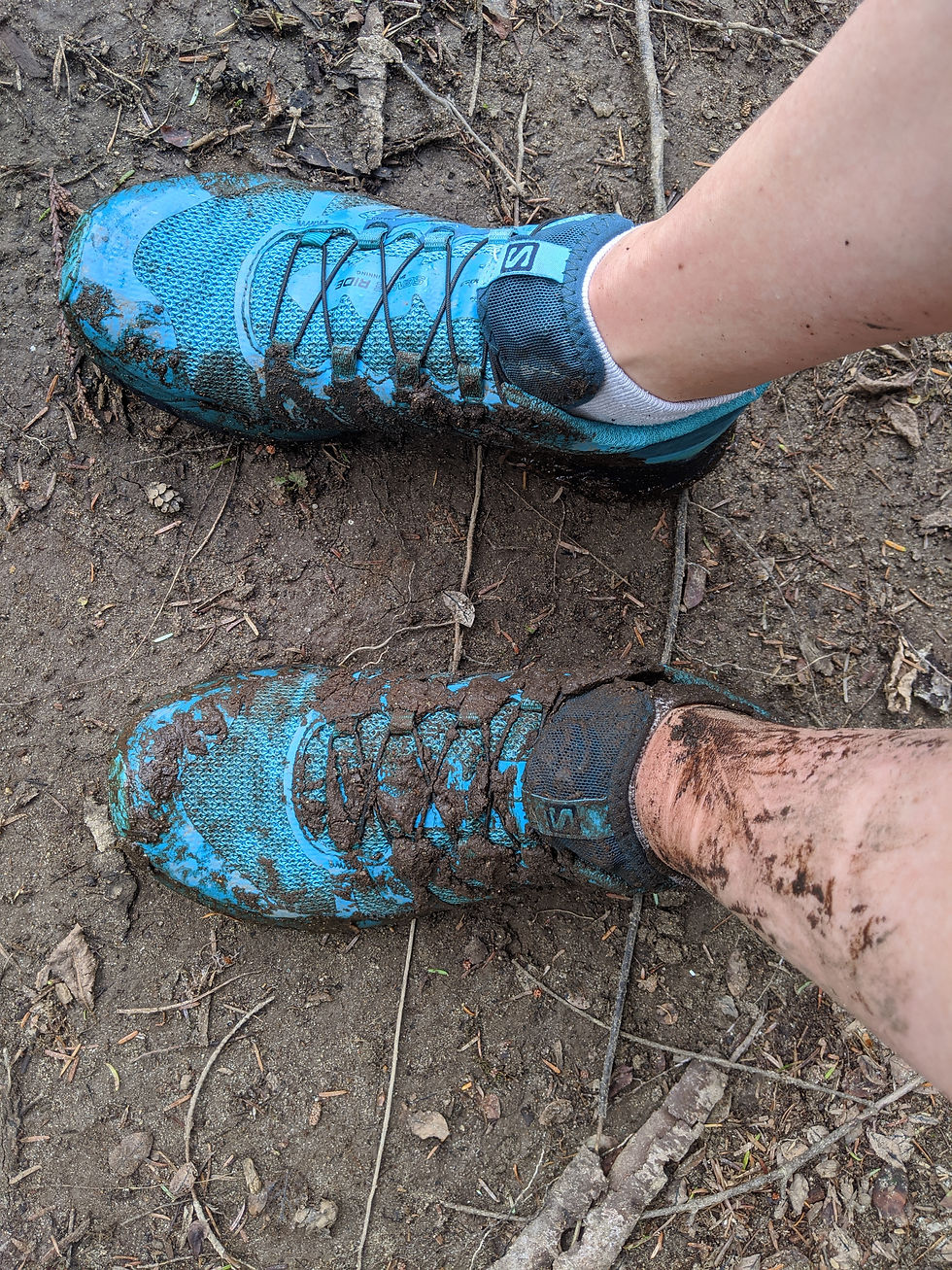
The trail changes constantly. A route that looks manageable on paper can feel completely different in rain, heat, mud, or with added fatigue. I can have a plan, but I still need to respond to what is actually in front of me and adjust my expectations accordingly.
That feels familiar in design. Every project begins with a direction, but like most work, there are often unexpected hurdles, curveballs, and changing timelines. A concept may need to change after research. A conversation with the client may reveal a problem that was not visible at the start. A budget constraint might now require a different solution.
Running teaches me that problem-solving is not always about finding the fastest route. Sometimes it is about staying observant, making the next good decision, and trusting that a series of small adjustments can still lead somewhere meaningful.
The trail gives my mind somewhere to go quiet
There are moments on the trail when running becomes surprisingly quiet. Especially on those long run days in the mountains, when the terrain becomes steep or technical, there is no room for my mind to be somewhere else. I am focused on my breath, my heart rate, the next few metres ahead, and not tripping or rolling my ankle on that tiny inconsequential root or rock (don’t worry, you’ll quickly learn that in trail running, the inconsequential rocks and roots is the things that you need to worry about). One foot in front of the other.
For someone whose mind is often full, always bouncing around from one thought to the next, never quite turning off fully, that kind of focus feels rare, and on the day-to-day, virtually impossible. But trail running, because it requires so much focused attention, narrows my mind and gives my brain only one task. It asks me to be fully present in my body instead of trying to solve everything at once. It’s what I think meditation would feel like… if I could ever keep up a regular practice with it.
That space that is created by running has become valuable to my creative work. Some ideas arrive while I am running, but more often, running helps me by creating room around the ideas that are already there but that I didn’t know of yet. It helps me process, reset, and return to my design and artwork with more clarity.
Not every creative problem needs to be solved at a desk - in fact, most problems are not solved by sitting at a desk and staring at a screen all day (What?! Who knew?!). Sometimes the most useful thing I can do is step away from the screen, move through the woods, and let my mind become quiet enough to notice what it has been trying to say.
Confidence.. what, who is she?
Before I started training for this race, the distance and elevation felt impossible to me. It still feels big. But each week of training has given me a little more evidence that I can meet challenges that once felt outside my reach.

Confidence does not come from convincing yourself that everything will be easy. It comes from doing difficult things, and seeing those difficult things through. Like completing a long run I was nervous about, making it to the top of the mountain when my legs already felt burnt out, doing long runs back-to-back or hill sprints and speed interval workouts for the first time.
That is the kind of confidence I want to bring into my work as a designer and artist. Not the confidence of always having the answer, but the confidence of knowing I can stay with a problem long enough to find one.
Every project, like every run, asks something different of me. But training is reminding me that my capability is not fixed, nor do I ever want it to be. It grows and changes through experience, repetition, and the willingness to try even if I don’t feel completely ready.
What ultra training is teaching me about design and art
While I do not know exactly what race day will feel like, I do know that I will likely go through the complete spectrum of human emotion; excitement, doubt, anger, fatigue, euphoria, relief, indifference, and just plain ol’ contentment. There will be parts that go according to plan and parts that require me to fight with myself to stay in it (I hear one section of this race is particularly grueling AND it happens to be around KM 60-67-ish, when you are already so far into the race, and also so close to the end - I look forward to dealing with the mental battle that will come with that section ;) ). But the race is not the only point of this experience.
And the reality is, most of these changes I am looking for are happening in the training, from my early mornings, long trail days, recovery time, building patience, and the repeated decision to get up every day for the next training session.
Training for an ultramarathon is making me more comfortable with uncertainty, more aware of my limits, and more willing to see the work through instead of wanting to complete it all once. Those are the lessons I am trying to bring with me into the studio, both with clients, and with my own art practice.
So, all this to say, running is not separate from my work as a graphic designer and artist. It has influenced my work dramatically, whether I was aware of it or not, and it is becoming a crucial part of my day-to-day life and work. So much so, that if running ever disappeared from my life completely, I know my work would suffer for a bit until I found another outlet that could offer me the same impact running has.
For you specifically, my hope is that you embark on your own ultramarathon of sorts, whatever that looks like, whether it is running or something different, if only to realize what you are truly capable of.

So, I wrote this blog well before I published it, but I did in fact run the race, and if you want to find out how it went, you can check it out here, on my instagram! https://www.instagram.com/p/DbMDZU7mPKE/?img_index=1